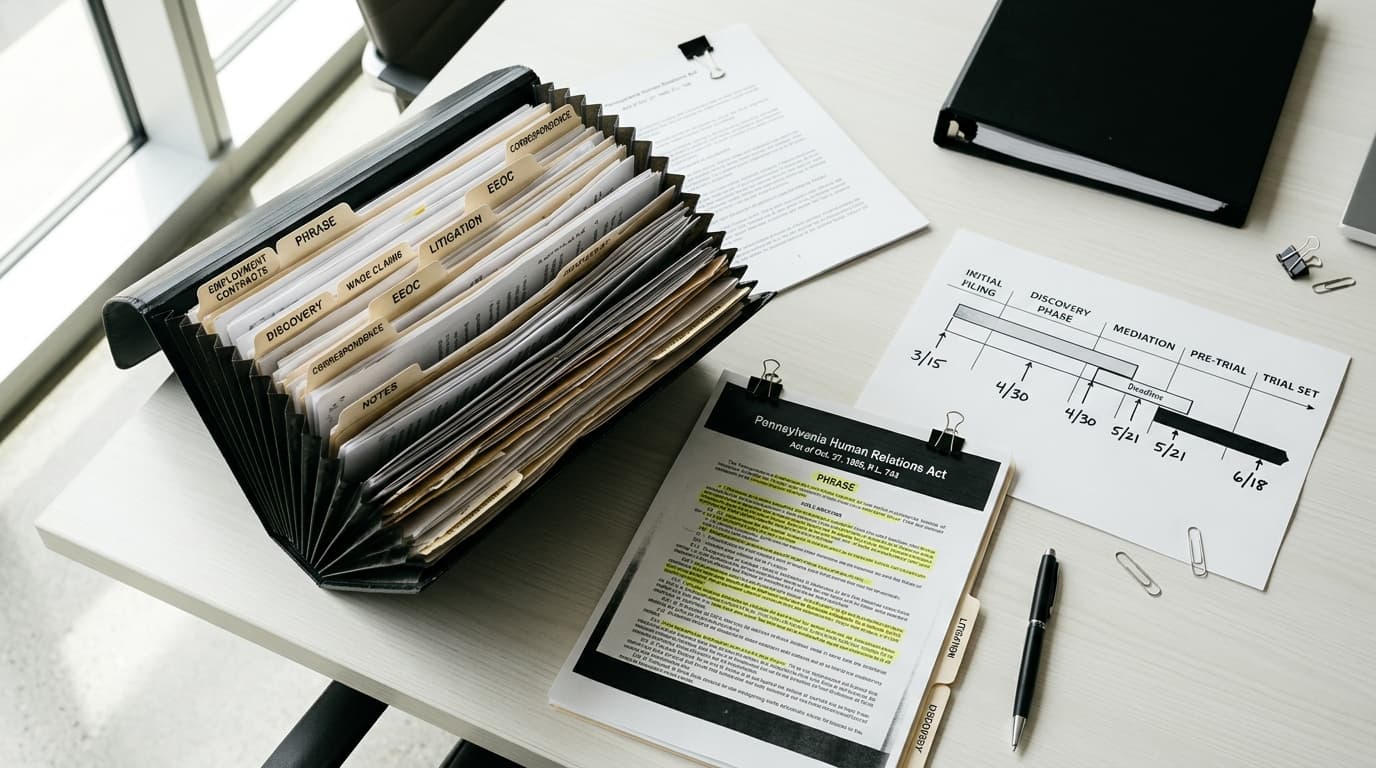
Pennsylvania employees who face workplace discrimination have two primary filing options: the Pennsylvania Human Relations Commission (PHRC) and the Equal Employment Opportunity Commission (EEOC). Filing with either agency within the correct deadline preserves your right to sue in court - missing those deadlines permanently bars your claim.
This guide walks you through every step of the process, explains which laws protect you, and clarifies how workers in Philadelphia, Bucks County, Montgomery County, Delaware County, Chester County, and South and Central Jersey can enforce their rights against employers who discriminate or harass.
Laws That Protect Pennsylvania and New Jersey Employees From Discrimination
Before filing, you need to identify which laws apply to your situation. Federal, state, and local statutes each cover different protected characteristics and employer sizes.
| Law | Jurisdiction | Protected Characteristics | Employer Size Threshold |
|---|---|---|---|
| Title VII (Civil Rights Act) | Federal | Race, color, religion, sex, national origin | 15+ employees |
| ADA (Americans with Disabilities Act) | Federal | Physical and mental disability | 15+ employees |
| ADEA (Age Discrimination in Employment Act) | Federal | Age 40 and older | 20+ employees |
| Pennsylvania Human Relations Act (PHRA) | State | Race, sex, age, religion, disability, ancestry, national origin, sexual orientation, gender identity | 4+ employees |
| Philadelphia Fair Practices Ordinance | Local | All PHRA categories plus familial status, marital status, and more | 1+ employees |
| New Jersey Law Against Discrimination (NJLAD) | State | Race, sex, religion, disability, sexual orientation, gender identity, pregnancy, and others | No minimum |
The PHRA and NJLAD are broader than federal law in two critical ways: they cover smaller employers, and they include sexual orientation and gender identity as explicitly protected characteristics. Workers at small businesses - including rowhome property managers, family-owned shops, and startups - often have state-law protections even when Title VII does not apply.
Step 1: Identify the Type of Discrimination or Harassment
Discrimination takes several legally recognized forms. Correctly categorizing your experience strengthens your claim from the start.
- Disparate treatment: Your employer treated you differently than similarly situated employees because of a protected characteristic - for example, denying a promotion to a Black employee while promoting a less-qualified white employee with the same performance record.
- Hostile work environment: Severe or pervasive conduct - slurs, unwanted touching, offensive images, or repeated demeaning comments - that alters the conditions of employment. A single extreme incident can qualify; minor annoyances do not.
- Sexual harassment: Quid pro quo harassment (a supervisor conditioning job benefits on sexual favors) or a hostile work environment based on sex. Both are cognizable under Title VII, the PHRA, and the NJLAD.
- Retaliation: Your employer demoted, fired, or otherwise punished you for complaining about discrimination, filing a charge, or participating in an investigation.
- Failure to accommodate: An employer who refuses to provide a reasonable accommodation for a disability or sincerely held religious belief without demonstrating undue hardship violates the ADA and PHRA.
Step 2: Preserve Evidence Immediately
Evidence collection begins before you file - and before your employer can delete records. Take these actions as soon as you recognize a problem:
- Save copies of emails, text messages, performance reviews, and internal communications to a personal device or account.
- Write a detailed, dated account of every discriminatory incident, including names of witnesses.
- Preserve any written or verbal HR complaints you submitted, along with the employer's response.
- Document comparator employees - colleagues outside your protected class who were treated more favorably in the same circumstances.
- Retain pay stubs and offer letters that show wage disparities.
Step 3: Understand the Filing Deadlines - They Are Strict
Deadline errors are the single most common reason valid discrimination claims are lost. In Pennsylvania, you have 300 days from the discriminatory act to file a charge with the EEOC or PHRC. Because the PHRC and EEOC have a work-sharing agreement, filing with one agency automatically cross-files with the other.
Philadelphia employees also have the option to file with the Philadelphia Commission on Human Relations (PCHR), which enforces the Fair Practices Ordinance. The PCHR deadline is 300 days for most claims.
New Jersey employees pursuing NJLAD claims do not need to file with an administrative agency before suing in court, but they must file a lawsuit within 2 years of the discriminatory act. However, filing with the New Jersey Division on Civil Rights (DCR) is an option and requires a filing within 180 days.
For sexual harassment claims under Title IX or claims involving federal contractors, different deadlines apply. Consulting a workplace discrimination lawyer in Philadelphia as soon as possible after an incident protects you from these complexities.
Step 4: File Your Charge With the PHRC or EEOC
Filing a charge is not the same as filing a lawsuit. It is an administrative complaint that triggers an investigation.
EEOC Online Portal: The EEOC's public portal at publicportal.eeoc.gov allows you to submit an inquiry and schedule an intake interview. After your interview, the EEOC issues a formal charge for your signature.
PHRC: You can submit a complaint online through the PHRC's e-filing system or in person at regional offices in Philadelphia, Pittsburgh, Harrisburg, or other locations. The PHRC has broader jurisdiction than the EEOC for smaller employers.
Your charge must identify the employer, describe the discriminatory acts, name the protected characteristic at issue, and specify the dates of the conduct. Accuracy matters - you generally cannot add entirely new theories after filing.
Step 5: Navigate the Investigation and Conciliation Process
After your charge is filed, the agency notifies your employer and begins an investigation. This process includes:
- A request for the employer's position statement and documents
- Witness interviews and site visits in some cases
- A determination of whether probable cause exists (PHRC) or whether there is reasonable cause to believe discrimination occurred (EEOC)
- A mandatory conciliation or mediation period if cause is found
If conciliation fails or the agency closes the investigation without resolution, the EEOC issues a Right to Sue letter, which gives you 90 days to file a federal lawsuit. The PHRC's process requires a one-year wait period before you can request a right-to-sue and pursue claims in Pennsylvania state court - another reason early filing matters.
Step 6: File a Lawsuit if Administrative Remedies Are Exhausted
A right-to-sue letter unlocks access to federal court under Title VII, the ADA, and the ADEA. State court claims under the PHRA follow different procedures. NJLAD claims can go directly to Superior Court without exhausting administrative remedies.
Remedies available in discrimination and harassment lawsuits include back pay, front pay, compensatory damages for emotional distress, punitive damages in cases of intentional misconduct, reinstatement, and attorney's fees. Under the NJLAD, there is no cap on punitive damages - a meaningful distinction for severe cases of sexual harassment in New Jersey.
Special Considerations for Philadelphia and South Jersey Employees
Philadelphia's Fair Practices Ordinance covers employers with even one employee, making it the broadest local protection in the region. The PCHR can order reinstatement, back pay, and civil penalties against employers. South Jersey workers benefit from the NJLAD's no-threshold employer coverage and its explicit prohibition of harassment based on sexual orientation and gender identity - protections that have been enforced vigorously in Camden, Burlington, and Gloucester County courts.
Workers in hostile work environment cases - including those involving rowhome property management companies, building contractors, and small businesses - frequently rely on state and local law precisely because their employer falls below the federal 15-employee minimum.
Employment Discrimination FAQ for Pennsylvania and New Jersey Workers
What qualifies as a hostile work environment under Pennsylvania law?
A hostile work environment exists when conduct based on a protected characteristic - such as race, sex, disability, or sexual orientation - is severe or pervasive enough to alter the terms and conditions of employment. Under the PHRA and Pennsylvania case law, courts evaluate the frequency of the conduct, its severity, whether it is physically threatening or humiliating, and whether it unreasonably interferes with work performance. A single severe act, such as a sexual assault at work, can establish a hostile work environment without requiring repeated incidents.
Do I have to file with the EEOC before suing my employer in Pennsylvania?
For federal claims under Title VII, the ADA, or the ADEA, yes - you must exhaust administrative remedies by filing an EEOC charge and receiving a right-to-sue letter before filing in federal court. For PHRA claims in Pennsylvania state court, you must file with the PHRC and wait one year before pursuing litigation unless the PHRC closes your case earlier. NJLAD claims in New Jersey Superior Court do not require administrative exhaustion.
How long does an EEOC investigation take?
EEOC investigations vary widely. The agency's median resolution time in recent fiscal years has exceeded 10 months for mediated cases and substantially longer for full investigations. If you need a right-to-sue letter sooner, you can request one after 180 days from the date of your charge, even if the investigation is ongoing. An EEOC claims attorney in Pennsylvania can advise whether requesting early dismissal and a right-to-sue letter serves your interests.
Can I be fired for filing a discrimination complaint?
Firing, demoting, reducing hours, or otherwise retaliating against an employee for filing a charge, reporting discrimination internally, or participating in an investigation is independently illegal under Title VII, the PHRA, and the NJLAD. Retaliation claims often succeed even when the underlying discrimination claim does not, because retaliation requires only a causal connection between the protected activity and the adverse action - not proof that the original discrimination occurred.
What damages can I recover in a workplace discrimination lawsuit?
Recoverable damages include lost wages (back pay from termination or demotion through trial), front pay for future earnings lost due to the discrimination, compensatory damages for emotional distress and reputational harm, punitive damages when the employer acted with malice or reckless indifference, and attorney's fees and litigation costs. Under the NJLAD, punitive damages are uncapped. Federal law caps combined compensatory and punitive damages between $50,000 and $300,000 depending on employer size - making state-law claims under the PHRA and NJLAD critically important for maximizing recovery.
Disclaimer: For informational purposes only; does not constitute legal advice. Always consult a licensed attorney regarding specific claims.
