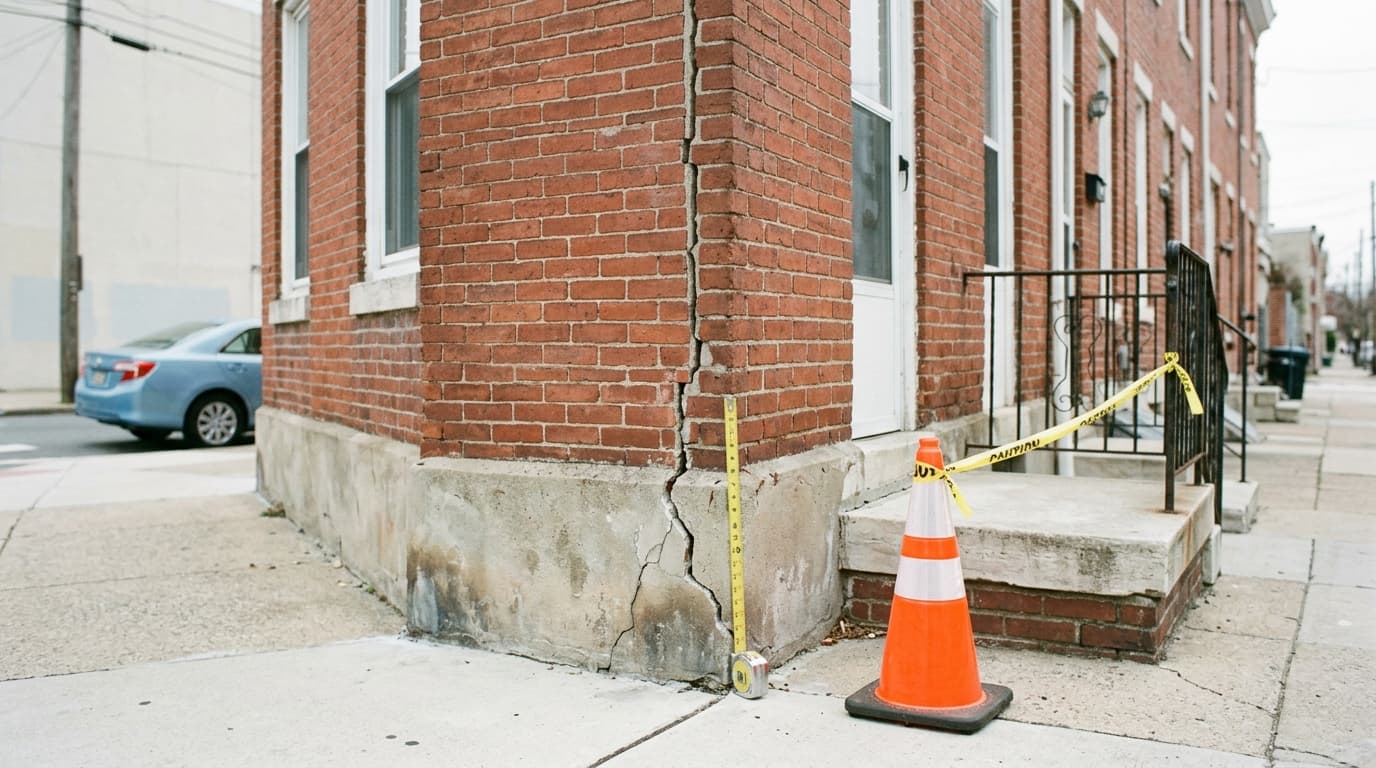
Philadelphia rowhome owners and tenants have concrete legal remedies when neighbor negligence or contractor misconduct causes property damage or personal injury - including premises liability claims, contractor negligence lawsuits, and bad faith insurance actions filed in Pennsylvania or New Jersey courts.
Philadelphia's dense rowhome neighborhoods - from Fishtown and South Philly to West Philadelphia and Kensington - create unique legal challenges. Shared walls, shared drainage systems, and contractor work that vibrates through an entire block mean one neighbor's renovation can crack your foundation, flood your basement, or collapse your retaining wall. Understanding your legal options before damage worsens is the difference between full compensation and absorbing the loss yourself.
How Philadelphia Rowhome Construction Creates Liability
Rowhomes share party walls - structural elements that both adjoining property owners have a legal interest in preserving. Under Pennsylvania property law, a neighbor who excavates near a party wall, removes lateral support, or conducts renovation work without proper shoring can be held strictly liable for resulting damage. Strict liability means you do not need to prove the neighbor was careless; damaging a shared structural element is itself the violation.
Contractor negligence follows a different but equally powerful legal theory. A licensed contractor who fails to obtain permits, ignores soil conditions, or skips required inspections breaches the professional standard of care owed to surrounding property owners. Pennsylvania courts have consistently held that contractors owe a duty of reasonable care not just to the person who hired them, but to foreseeable third parties - including next-door neighbors - who suffer harm from shoddy work.
Common Rowhome Disputes and Their Legal Theories
- Foundation and structural cracking caused by neighbor excavation or underpinning work - actionable under lateral support doctrine and negligence
- Water intrusion and flooding from improper grading, blocked downspouts redirected onto adjacent property, or failed waterproofing - actionable as private nuisance and trespass
- Slip and fall injuries on shared walkways, steps, or entry areas left in disrepair - actionable under premises liability law
- Falling debris or scaffolding injuries from construction work on neighboring properties - actionable under contractor negligence and, in some cases, strict liability for ultrahazardous activity
- Negligent security failures in multi-unit rowhome conversions where broken locks, unlit stairwells, or malfunctioning entry systems enable criminal attacks - actionable under negligent security doctrine
- Mold and habitability damage traced to a neighbor's unaddressed water source - actionable as nuisance and potentially covered under your homeowner's or renter's policy
Premises Liability in Philadelphia: What Property Owners Owe You
Pennsylvania premises liability law imposes a duty of care on property owners based on the visitor's status. Invitees - people present with the owner's express or implied permission for a business or social purpose - receive the highest protection. The owner must inspect, discover, and repair or warn of hazards. Licensees receive warnings about known dangers. Trespassers generally receive only the duty to avoid willful harm, with exceptions for child trespassers under the attractive nuisance doctrine.
In rowhome contexts, premises liability claims most often arise from:
- Cracked or heaving sidewalks and front steps left unrepaired after freeze-thaw cycles
- Shared vestibules, stairwells, and hallways in converted multi-unit rowhomes kept dark or cluttered by a landlord
- Contractor-created hazards - open trenches, loose debris, unmarked drop-offs - left accessible to pedestrians on adjacent sidewalks
- Icy alleys or rear access pathways in row-block configurations where drainage has been negligently altered
A premises liability lawyer in Philadelphia will evaluate the property owner's knowledge of the hazard - actual knowledge (they knew) or constructive knowledge (a reasonable inspection would have revealed it) - and calculate damages including medical expenses, lost wages, pain and suffering, and future care costs.
Negligent Security Claims in Rowhome Conversions and Multi-Unit Properties
Negligent security is a subset of premises liability that applies when a property owner's failure to provide adequate security measures foreseeably allows a criminal act to harm a tenant, guest, or visitor. In converted Philadelphia rowhomes - buildings that once housed a single family and now contain three or four rental units - landlords frequently cut corners on security infrastructure.
Negligent security claims succeed when the plaintiff establishes:
- The property owner knew or should have known the area had elevated crime risk (police reports, prior incidents, neighborhood crime data)
- The owner failed to implement reasonable security measures (functioning locks, exterior lighting, intercom systems, security cameras)
- That failure was a proximate cause of the plaintiff's injury
New Jersey rowhome and apartment tenants in Camden, Trenton, and South Jersey communities have parallel protections under NJ premises liability law. A negligent security lawyer in NJ can pursue compensation for assault, robbery, or sexual assault injuries tied to a landlord's deliberate indifference to documented security failures.
Premises Liability vs. Contractor Negligence: 5 Key Differences
| Factor | Premises Liability | Contractor Negligence |
|---|---|---|
| Who is liable | Property owner or landlord | General contractor, subcontractor, or both |
| Legal theory | Duty of care based on property ownership | Professional standard of care breach |
| Insurance source | Homeowner's or landlord's liability policy | Contractor's commercial general liability policy |
| Permit violations | Less central - focuses on physical condition | Highly relevant - permits establish standard of care |
| PA statute of limitations | 2 years from injury date | 2 years from injury; 4 years for contract-based property damage claims |
What to Do Immediately After Rowhome Property Damage or Injury
The steps you take in the first 72 hours directly affect the strength of your legal claim. Evidence deteriorates, contractors resume work that buries causation, and witnesses become harder to locate.
- Document everything photographically- shoot wide-angle and close-up images of all damage, including timestamps. Video is better than still photography for showing structural movement or active water intrusion.
- Obtain the permits and inspection records- Philadelphia's Department of Licenses and Inspections (L&I) maintains public records of permits pulled for neighboring properties. Missing permits are powerful evidence of negligence.
- Send written notice- a certified letter to the neighbor or contractor documenting the damage creates a record and may trigger their insurance carrier's involvement.
- Contact your own insurer- file a claim under your homeowner's policy even if you intend to pursue the responsible party. Your insurer may subrogate (recover from the at-fault party's insurer on your behalf).
- Retain a structural engineer- an independent engineering report establishing causation is frequently the centerpiece of rowhome damage litigation.
- Consult a Philadelphia property damage attorney- before signing any release or accepting any settlement offer from a neighbor's insurer.
Unsafe Property Claims and Bad Faith Insurance Practices
When damage is clear but an insurance carrier drags out the claim, low-balls the estimate, or denies coverage without a reasonable basis, Pennsylvania's Bad Faith statute (42 Pa. C.S. § 8371) allows policyholders to pursue punitive damages and attorney fees in addition to the underlying claim value. Bad faith claims in rowhome disputes arise most often when:
- A carrier denies structural damage as "pre-existing" without conducting an adequate investigation
- An insurer delays payment past the required timeframe while commissioning multiple re-inspections
- A liability carrier for a neighbor or contractor refuses to defend a claim that is clearly covered under their policy
New Jersey policyholders have parallel protections under the NJ Consumer Fraud Act and established bad faith case law. An unsafe property claims attorney can evaluate whether your carrier's conduct crosses the threshold from aggressive negotiation into actionable bad faith.
Philadelphia Rowhome Property Damage FAQ
Can I sue my neighbor if their contractor damaged my rowhome?
Yes. You can pursue both the neighbor and the contractor. The neighbor may be liable for authorizing work that damaged your property, while the contractor is separately liable for failing to meet the professional standard of care. Pennsylvania law allows you to name multiple defendants in the same lawsuit.
What is the statute of limitations for a slip and fall injury in Pennsylvania?
Pennsylvania imposes a 2-year statute of limitations on personal injury claims, including slip and fall cases, running from the date of the injury. Missing this deadline almost always bars your claim permanently, regardless of how strong the underlying evidence is.
Does premises liability apply to injuries on a neighbor's front steps in Philadelphia?
Yes. Philadelphia homeowners have a legal duty to maintain their front steps, sidewalk aprons, and entry areas in a reasonably safe condition. If a cracked or icy step causes your injury and the homeowner knew or should have known about the defect, you have a valid premises liability claim.
What makes a negligent security claim viable in a Philadelphia or NJ rowhome building?
A negligent security claim requires proof that crime was foreseeable at that location (demonstrated through prior incidents or neighborhood crime data), that the landlord failed to implement reasonable precautions, and that this failure directly caused your injury. The strength of the claim rises significantly when the landlord had prior written notice of security deficiencies and took no action.
How long does a rowhome property damage lawsuit typically take in Philadelphia?
Straightforward neighbor disputes with clear liability and a cooperative insurer can resolve in 6 to 12 months. Complex cases involving contested causation, multiple contractors, or bad faith insurance conduct routinely take 18 to 36 months through the Philadelphia Court of Common Pleas. Retaining an experienced attorney early accelerates the process by preserving evidence and applying leverage during pre-litigation negotiations.
Disclaimer: For informational purposes only; does not constitute legal advice. Always consult a licensed attorney regarding specific claims.
