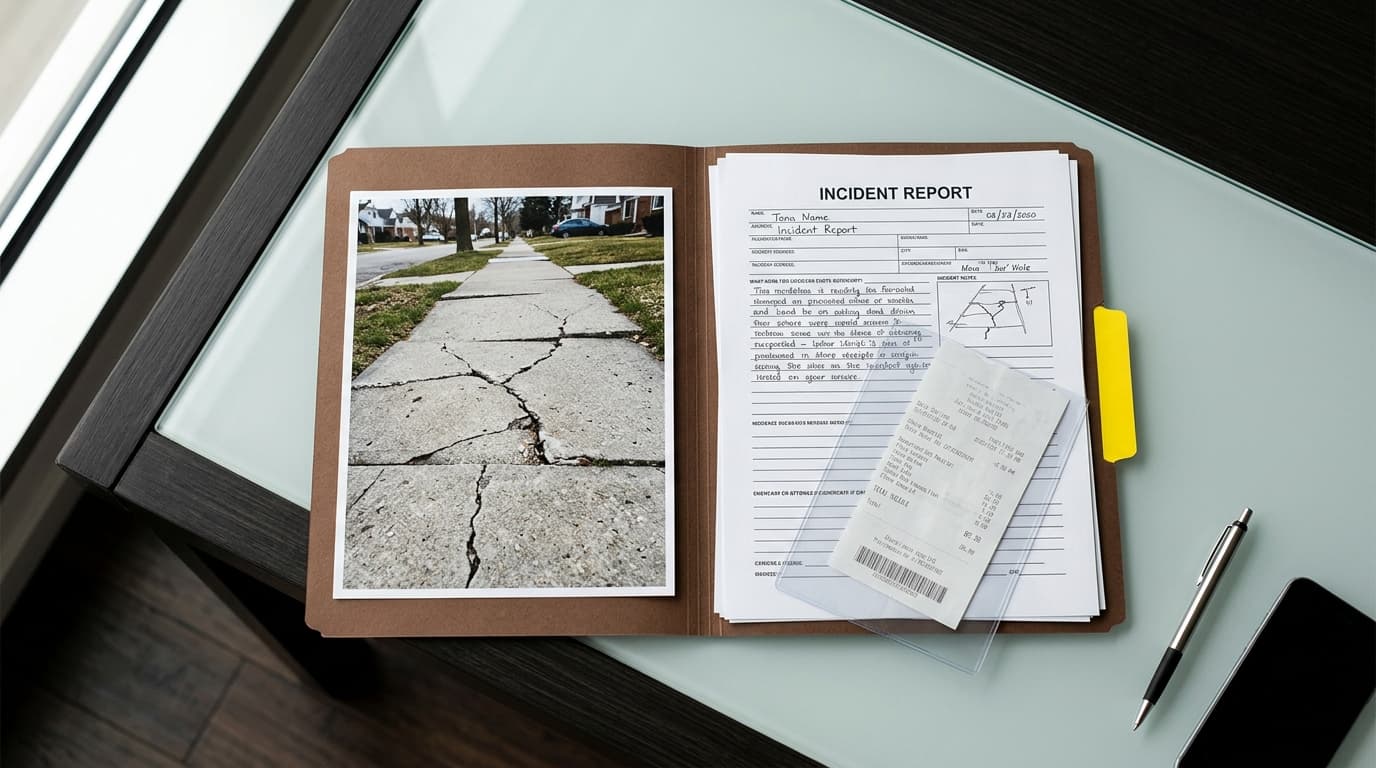
To win a slip and fall case in Pennsylvania, you must prove four elements: the property owner owed you a duty of care, they breached that duty by allowing an unsafe condition to exist, that condition directly caused your injury, and you suffered measurable damages as a result. Without documented evidence linking each element, even a legitimate claim can fail.
Pennsylvania follows a modified comparative negligence rule under 42 Pa. C.S. § 7102. This means you can recover compensation as long as you are found less than 51% at fault for the accident. However, your award is reduced by your percentage of fault - so if a jury finds you 20% responsible for your fall, your $100,000 verdict becomes $80,000. This makes it critical to build airtight evidence from the moment the injury occurs.
The Legal Standard: What "Negligence" Actually Means on Someone Else's Property
Pennsylvania premises liability law distinguishes between three categories of visitors: invitees (customers, guests invited for a business purpose), licensees (social guests), and trespassers. Property owners owe the highest duty of care to invitees - they must actively inspect the property and correct or warn of known hazards. If you slipped on a wet floor in a Philadelphia grocery store or fell on a broken sidewalk outside a Bucks County shopping center, you were almost certainly an invitee, and the owner had a legal obligation to keep that space reasonably safe.
The central question in most slip and fall cases is whether the property owner knew or should have known about the dangerous condition and failed to fix it in a reasonable amount of time. A puddle that formed two minutes before you fell is a harder case than one that employees walked past for three hours without placing a warning sign.
Critical Evidence You Need to Collect After a Slip and Fall
The strength of your premises liability claim depends directly on the quality and completeness of your evidence. Below is a breakdown of the most important categories:
Surveillance and Security Footage
Video footage is the single most powerful piece of evidence in a slip and fall case. It can show exactly how long a hazard existed before your fall, whether employees walked past it, and the precise mechanics of the accident itself. Pennsylvania courts have allowed juries to draw adverse inferences when property owners fail to preserve surveillance footage after receiving notice of a claim. A premises liability lawyer in Philadelphia should send a litigation hold letter within days of retaining your case - many commercial properties overwrite footage on 30- to 72-hour cycles.
Incident Reports
Report the accident to the property manager, store supervisor, or building owner immediately. Insist that an incident report is completed and request a copy before you leave. This creates a contemporaneous record that the accident happened, where it happened, and who was present. If the property owner later denies the fall occurred, the incident report becomes indispensable.
Photographic and Video Evidence
Photograph everything at the scene: the hazard itself (the wet floor, cracked pavement, icy walkway, broken step), the area surrounding it, any warning signs - or the absence of them - and your injuries. Take wide-angle shots to establish context and close-ups to document the specific defect. If your footwear is relevant, photograph that too.
Witness Statements
Identify anyone who saw the fall or was aware of the hazardous condition beforehand. Get their names and contact information at the scene. Witness testimony that an employee acknowledged the spill earlier, or that complaints had been made about broken pavement in a Chester County parking lot, can substantially strengthen your case.
Medical Records and Documentation
Seek medical attention the same day as the accident - ideally immediately. Gaps in medical treatment are routinely used by insurance defense lawyers to argue your injuries are not serious or were caused by something else. Keep records of every diagnosis, treatment, physical therapy session, and prescription related to your injuries. Out-of-pocket expenses, lost wages, and documentation of how the injury has affected your daily life all support your damages claim.
Maintenance and Inspection Logs
Through the discovery process, your attorney can subpoena the property's maintenance records, cleaning schedules, and prior incident reports. If a Montgomery County apartment building had a history of icy walkway complaints that management ignored, those records become powerful evidence of notice and systemic negligence.
Slip and Fall vs. Negligent Security: Key Differences
Not all premises liability claims involve a physical hazard like a wet floor. Negligent security cases arise when a property owner fails to provide adequate security measures and a visitor is harmed - typically through assault, robbery, or sexual attack. These claims are especially common in Philadelphia apartment complexes, parking garages, South Jersey hotels, and entertainment venues.
| Factor | Slip and Fall | Negligent Security |
|---|---|---|
| Primary hazard | Physical condition (wet floor, broken step, ice) | Absence of security measures (lighting, cameras, guards) |
| Cause of injury | Property defect | Third-party criminal act enabled by owner's failure |
| Key evidence | Footage, maintenance logs, hazard photos | Crime statistics, prior incidents at location, security policies |
| Notice standard | Owner knew or should have known of defect | Owner knew or should have known crime was foreseeable |
| Applicable states | Pennsylvania and New Jersey | Pennsylvania and New Jersey (NJ standards differ slightly) |
| Common venues | Retail stores, sidewalks, stairwells | Parking lots, apartment buildings, bars, hotels |
If you were attacked in a Delaware County parking garage or assaulted in a North Jersey hotel, a negligent security lawyer will investigate whether the property owner had prior knowledge of criminal activity on or near the premises and failed to take reasonable precautions.
Pennsylvania's Statute of Limitations for Premises Liability Claims
In Pennsylvania, the statute of limitations for a personal injury claim - including slip and fall and negligent security - is two years from the date of injury under 42 Pa. C.S. § 5524. New Jersey's statute of limitations is also two years. Missing this deadline almost always results in a permanent bar to recovery, regardless of how strong your evidence is. Certain exceptions apply - including for minors and cases involving delayed discovery of an injury - but these are narrow and must be evaluated by an attorney promptly.
How Philadelphia-Area Property Disputes Add Complexity
Philadelphia's dense urban environment - rowhouses, shared driveways, adjoining party walls, and mixed-use commercial properties - creates unique premises liability situations. Sidewalk maintenance in Philadelphia is the legal responsibility of the abutting property owner under Philadelphia Code § 11-600, not the city, in most circumstances. This means a fall on a broken or upheaved sidewalk slab in South Philadelphia or Fishtown can support a private lawsuit against the homeowner or building owner.
Similarly, properties in Bucks County and Montgomery County with shared access easements or HOA-maintained common areas raise questions about which entity is legally responsible for maintaining safe conditions. An experienced unsafe property claims attorney familiar with the Philadelphia metro area can identify the correct defendants before the statute of limitations expires.
Why Evidence Preservation Determines Whether Your Case Settles or Goes to Trial
Insurance adjusters for large retailers and property management companies are trained to minimize payouts. They will argue that the hazard was open and obvious, that you were not paying attention, or that the condition existed for only a brief time. Comprehensive, time-stamped evidence dismantles each of these defenses. Cases with strong surveillance footage, documented maintenance failures, and consistent medical records settle significantly faster and for higher amounts than cases built on testimony alone.
A qualified slip and fall attorney in Pennsylvania will issue preservation demands immediately, retain expert witnesses - including engineers or safety consultants who can testify about code violations - and file suit before the limitations period closes if a fair settlement is not offered.
Slip and Fall Premises Liability FAQ
How long do I have to file a slip and fall lawsuit in Pennsylvania?
Pennsylvania law gives you two years from the date of injury to file a personal injury lawsuit under 42 Pa. C.S. § 5524. Waiting too long forfeits your right to compensation permanently. Contact an attorney as soon as possible to preserve evidence and meet all deadlines.
What if I was partially at fault for my fall?
Under Pennsylvania's modified comparative negligence rule, you can still recover damages if you are found less than 51% responsible. Your compensation is reduced proportionally - so 30% fault on a $200,000 claim results in a $140,000 recovery. An attorney helps minimize the fault percentage attributed to you during negotiations and at trial.
Can I sue if I slipped on ice or snow outside a business in Philadelphia?
Yes. Pennsylvania property owners have a duty to address accumulated ice and snow within a reasonable time after a storm ends. If a business failed to salt or clear a walkway for hours after precipitation stopped and you were injured, that constitutes a breach of their duty of care to invitees.
What is negligent security, and how is it different from a typical slip and fall?
Negligent security claims arise when a property owner fails to implement reasonable security measures - adequate lighting, working locks, security cameras, or on-site guards - and a visitor is harmed by a third party's criminal act as a result. A negligent security lawyer in NJ or PA evaluates whether the criminal act was foreseeable based on the property's location, prior incidents, and the owner's security policies.
What damages can I recover in a Pennsylvania premises liability case?
Recoverable damages include medical expenses (past and future), lost wages and diminished earning capacity, pain and suffering, emotional distress, and loss of enjoyment of life. In cases involving egregious conduct - such as a property owner who knowingly concealed a known hazard - punitive damages may also be available under Pennsylvania law.
Disclaimer: For informational purposes only; does not constitute legal advice. Always consult a licensed attorney regarding specific claims.
