Pennsylvania's Choice No-Fault Insurance System: What Full Tort vs. Limited Tort Means for Your Accident Claim
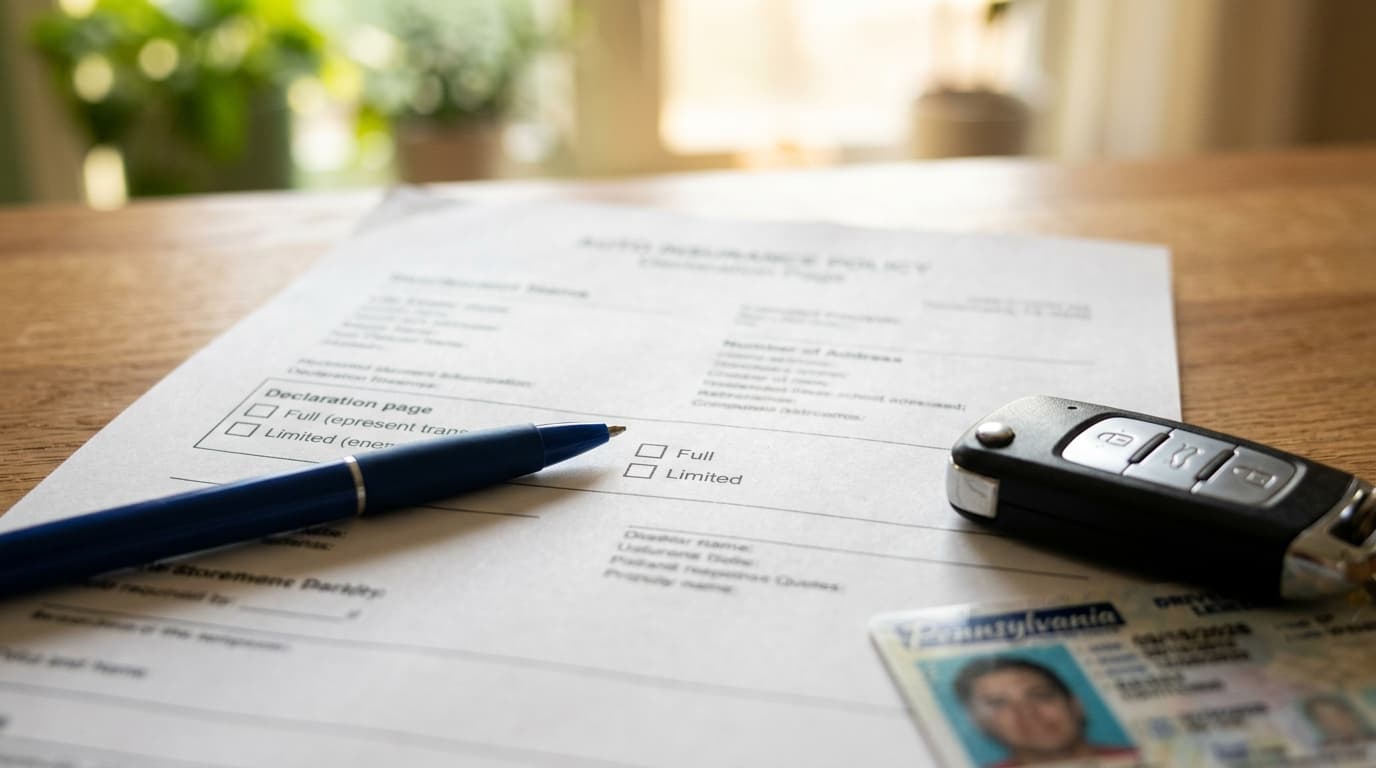
Pennsylvania's "choice no-fault" system requires every driver to elect either Full Tort or Limited Tort coverage at the time of purchasing auto insurance - and that single checkbox determines whether you can sue for pain and suffering after a car, truck, motorcycle, or pedestrian accident. Choosing Limited Tort can eliminate your right to recover non-economic damages unless your injuries meet a strict "serious injury" threshold defined under 75 Pa. C.S. § 1705.
For accident victims in Philadelphia, Bucks County, Montgomery County, and throughout the Pennsylvania and New Jersey region, understanding this distinction before an accident happens - and knowing how to challenge it after one - is the difference between a full recovery and a severely limited settlement.
How Pennsylvania's Choice No-Fault System Works
Pennsylvania operates as a hybrid "choice no-fault" state, unlike New Jersey's mandatory no-fault framework or the pure at-fault systems used in most states. When you purchase auto insurance in Pennsylvania, your insurer must offer you two tort options:
- Full Tort: You retain the unrestricted right to sue the at-fault driver for all damages, including pain and suffering, emotional distress, and diminished quality of life, regardless of injury severity.
- Limited Tort: You waive the right to sue for non-economic damages unless your injuries qualify as "serious" under Pennsylvania law. In exchange, you typically pay a lower insurance premium.
Most insurers present this as a cost-saving option, and many drivers select Limited Tort without understanding the legal consequences. A 2024 Pennsylvania Insurance Department report found that a significant portion of Pennsylvania drivers carried Limited Tort policies - often without realizing the implications until after a crash.
What Counts as a "Serious Injury" Under Limited Tort
Under 75 Pa. C.S. § 1705(d), a Limited Tort policyholder can still sue for pain and suffering if the injury qualifies as "serious." Pennsylvania courts and the statute define serious injury as:
- Death
- Serious impairment of a body function
- Permanent serious disfigurement
The phrase "serious impairment of a body function" has been litigated extensively in Pennsylvania courts. Injuries that appear significant - herniated discs, torn ligaments, nerve damage - do not automatically qualify. Courts examine whether the impairment affects the plaintiff's ability to lead a normal life and perform daily activities. A Pennsylvania Supreme Court decision in Washington v. Baxter established that this is a fact-specific inquiry examined case by case, not a bright-line rule.
Full Tort vs. Limited Tort: A Direct Comparison
| Factor | Full Tort | Limited Tort |
|---|---|---|
| Right to sue for pain and suffering | Unrestricted | Only if injury is "serious" |
| Medical expense recovery | Yes | Yes |
| Lost wage recovery | Yes | Yes |
| Non-economic damages (emotional distress, quality of life) | Yes | Only if serious injury threshold met |
| Typical premium cost | Higher | Lower |
| Legal complexity after accident | Lower | Higher - threshold dispute likely |
Exceptions That Override Limited Tort Restrictions
Pennsylvania law carves out several situations where a Limited Tort election does not bar pain and suffering claims. A car accident lawyer in Philadelphia will immediately evaluate whether any of these exceptions apply to your case:
- The at-fault driver was uninsured at the time of the accident.
- The at-fault driver was driving under the influence of alcohol or a controlled substance.
- The at-fault driver was operating a vehicle registered in another state.
- The at-fault driver acted intentionally to cause harm.
- The injured person was a pedestrian, bicyclist, or motorcycle rider at the time of the accident - motorcycle accident claims in PA operate under distinct rules because motorcycles are excluded from the Pennsylvania Motor Vehicle Financial Responsibility Law's no-fault provisions entirely.
That last exception is critical. Motorcyclists in Pennsylvania are categorically excluded from no-fault coverage, meaning they always retain Full Tort rights regardless of what their policy states. Similarly, pedestrian accident victims do not operate motor vehicles and are not bound by any tort election.
Motorcycle Accident Claims in Pennsylvania: Different Rules Apply
Pennsylvania's no-fault system does not apply to motorcycles. Motorcyclists are not entitled to first-party medical benefits under the Motor Vehicle Financial Responsibility Law, but they face no tort limitation either. A motorcyclist injured by a negligent driver files a traditional negligence claim without any serious injury threshold barrier - making motorcycle accident claims in PA legally distinct from standard car accident cases.
This matters enormously in Philadelphia and throughout the Pennsylvania-New Jersey corridor, where motorcycle accidents frequently involve commercial trucks, distracted drivers, and poorly maintained roadways. Comparative negligence rules still apply: under Pennsylvania's modified comparative fault system, a motorcyclist more than 50% at fault cannot recover damages.
Truck Accident Claims in New Jersey: No-Fault Meets Commercial Liability
New Jersey operates a mandatory no-fault system with its own verbal threshold and limitation on lawsuit (LOU) options. However, commercial truck accidents in New Jersey - governed by federal regulations under the Federal Motor Carrier Safety Administration (FMCSA) - introduce a separate layer of liability that frequently overrides standard no-fault limitations.
When a commercial carrier is involved, a truck accident attorney in NJ pursues claims directly against the trucking company under theories of negligent entrustment, negligent hiring, and vicarious liability. Federal regulations require commercial carriers to maintain minimum liability coverage of $750,000 under 49 C.F.R. § 387.9 - and that floor climbs to $5,000,000 for carriers transporting certain hazardous materials. These policies exist outside the no-fault framework entirely, meaning victims can pursue full compensatory and punitive damages without the verbal threshold limiting their recovery.
Pedestrian Accidents: No Tort Election Applies
Pedestrians injured by vehicles in Pennsylvania are among the most legally protected accident victims in the state. Because a pedestrian has no motor vehicle and made no tort election, they retain full rights to sue for pain and suffering from dollar one. A pedestrian accident lawyer handling Philadelphia-area cases will pursue claims against the driver's liability policy, uninsured motorist coverage if applicable, and - in cases involving defective crosswalks or traffic signals - municipal liability under the Pennsylvania Tort Claims Act.
Municipalities enjoy sovereign immunity with limited exceptions, and the dangerous condition of a road or sidewalk must meet a specific statutory waiver. Cases involving Philadelphia city streets, SEPTA vehicles, or PennDOT-maintained roads require careful notice procedures and shorter claim windows that a pedestrian accident lawyer must navigate immediately after the injury.
What to Do Immediately After Any Traffic Accident in Pennsylvania or New Jersey
- Seek emergency medical treatment and document every symptom, even those that seem minor.
- Obtain the police report number at the scene.
- Photograph vehicle damage, road conditions, skid marks, and your injuries.
- Do not provide a recorded statement to any insurer before consulting an attorney.
- Contact a Philadelphia-area accident attorney within days - Pennsylvania's statute of limitations for personal injury is 2 years under 42 Pa. C.S. § 5524, but evidence preservation is time-sensitive.
Pennsylvania Tort Election FAQ
Can I change my tort election from Limited Tort to Full Tort after an accident?
No. Your tort election is fixed at the time you purchase or renew your policy. It cannot be changed retroactively after an accident occurs. You can, however, elect Full Tort at your next renewal period, and an attorney can evaluate whether exceptions to your Limited Tort election apply to your specific claim.
Does Limited Tort prevent me from recovering all damages after a car accident in Pennsylvania?
No. Limited Tort only restricts non-economic damages like pain and suffering. You retain the full right to recover economic damages - medical expenses, lost wages, and property damage - regardless of your tort election or injury severity.
Are motorcycle riders subject to Pennsylvania's tort election rules?
No. Motorcycles are excluded from the Pennsylvania Motor Vehicle Financial Responsibility Law's no-fault provisions. Motorcycle accident claims in PA proceed under traditional tort law, giving riders full rights to sue for pain, suffering, and all other damages without meeting a serious injury threshold.
How does a truck accident attorney in NJ handle cases against commercial carriers?
A truck accident attorney in NJ pursues claims under federal motor carrier regulations, FMCSA compliance records, driver hours-of-service logs, and black box data from the commercial vehicle. Commercial truck claims operate outside New Jersey's standard no-fault framework, enabling recovery of full compensatory damages directly from the carrier's commercial liability policy.
What is the statute of limitations for a pedestrian accident claim in Pennsylvania?
Pennsylvania's standard personal injury statute of limitations is 2 years from the date of injury under 42 Pa. C.S. § 5524. Claims against government entities - including Philadelphia, PennDOT, or SEPTA - require a formal notice of intent within 6 months of the incident under the Pennsylvania Tort Claims Act, making immediate contact with a pedestrian accident lawyer essential.
Disclaimer: For informational purposes only; does not constitute legal advice. Always consult a licensed attorney regarding specific claims.
