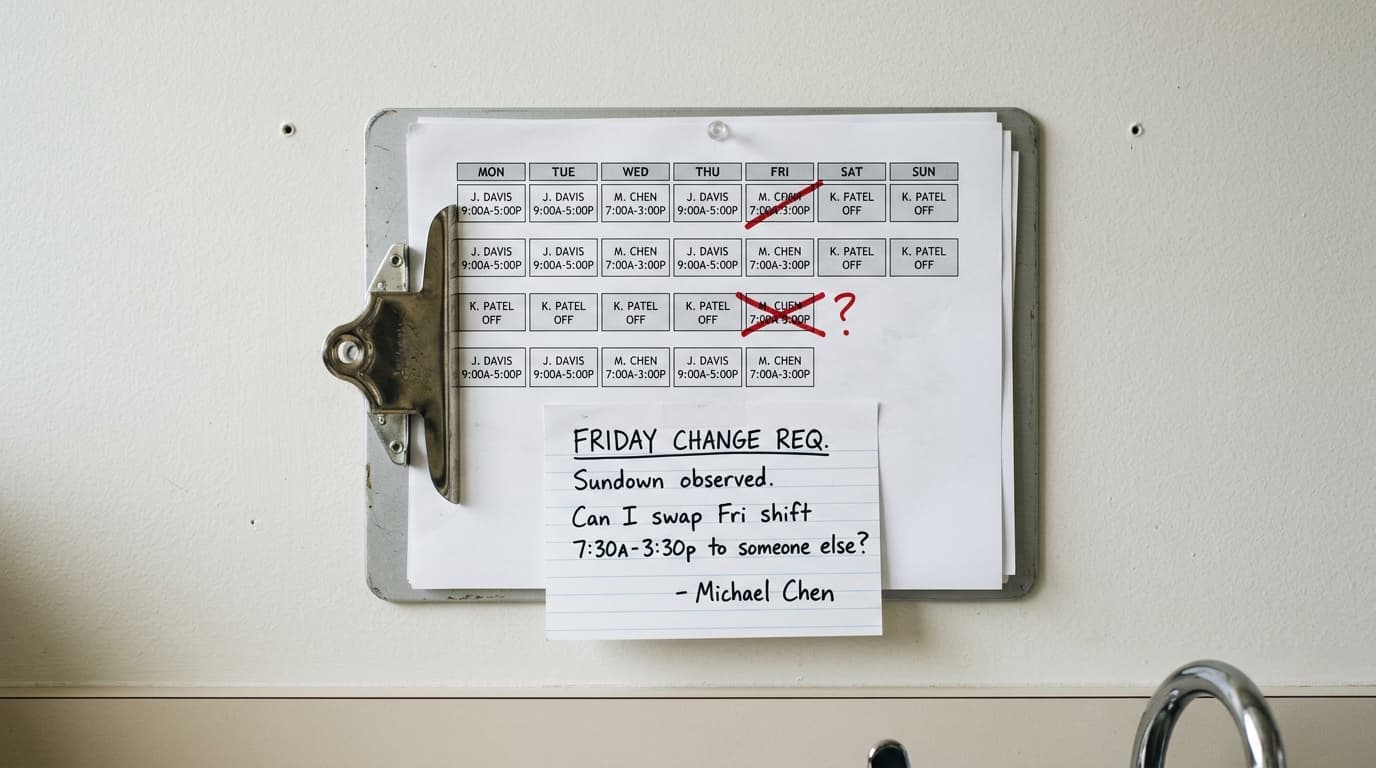
Religious Accommodation in New Jersey: What the Law Actually Requires
Under Title VII of the Civil Rights Act of 1964, the New Jersey Law Against Discrimination (NJLAD), and the Pennsylvania Human Relations Act (PHRA), employers must provide reasonable religious accommodations to employees unless doing so would cause an undue hardship to the business. This obligation extends to sincerely held religious beliefs, observance practices, and moral or ethical convictions that function like religion, including atheism and agnosticism. If your employer has refused a scheduling change, forced you to violate a religious practice, or retaliated against you for requesting an accommodation, that conduct is illegal.
This guide explains exactly how the accommodation process works, what employers can and cannot do, and how racial, national origin, and religious discrimination frequently intersect in real workplace situations. If you are facing any of these issues in the Philadelphia metro area, South Jersey, or Central Jersey, understanding these overlapping protections is your first step toward taking action.
Title VII, NJLAD, and PHRA: How the Three Laws Stack Up
Most employees in the New Jersey and Pennsylvania region have protection under at least two of these statutes simultaneously. Knowing which law applies, and how each defines your rights, directly affects your litigation strategy, filing deadlines, and available remedies.
| Feature | Title VII (Federal) | NJLAD (New Jersey) | PHRA (Pennsylvania) |
|---|---|---|---|
| Employer size threshold | 15 or more employees | 1 or more employees | 4 or more employees |
| Filing deadline (discrimination charge) | 300 days (dual-filing states like NJ and PA) | 2 years (direct civil lawsuit) | 180 days (PHRC) or 300 days if dual-filed with EEOC |
| Undue hardship standard | Substantial cost/burden (post-Groff v. DeJoy, 2023) | Substantial burden on business operations | Substantial cost or operational disruption |
| Personal liability for supervisors | No | Yes, under aiding and abetting theory | No |
| Compensatory and punitive damages cap | $300,000 (employers with 500+ employees) | No statutory cap | No statutory cap |
The NJLAD's lack of a damages cap and its coverage of even single-employee businesses make it the strongest standalone protection for most New Jersey workers. In Pennsylvania, employees often file concurrently with the EEOC and PHRC to preserve all options.
What Counts as a "Sincerely Held" Religious Belief
Employers frequently challenge accommodation requests by arguing the employee's belief is not genuinely religious. Courts apply a broad, subjective standard: the belief does not need to be part of a formal religion, recognized denomination, or traditional doctrine. It only needs to be sincere and occupy a place in the employee's life similar to the role orthodox religious beliefs play in others' lives.
Courts have recognized protection for beliefs including: dietary restrictions tied to spiritual practice, refusal to work on specific days of rest, wearing head coverings, beards, or religious garments, and objections to specific oaths or pledges. Importantly, the belief does not need to be consistent across all situations. An employee who observes the Sabbath but occasionally makes exceptions in emergencies does not forfeit protection.
What employers can legitimately do is ask questions designed to understand the nature of the belief and the specific accommodation needed. They cannot demand documentation of church membership, require a clergy letter as a prerequisite, or deny the request simply because the belief seems unusual.
The Interactive Process: Your Obligation and Your Employer's Obligation
Once you notify your employer of a conflict between a workplace policy and a sincerely held religious belief, the law requires both parties to engage in a good-faith interactive process to identify a workable accommodation. Here is how that process should unfold:
- Submit a written request. Oral requests are legally sufficient but create evidentiary problems. A written request, sent by email or through HR, creates a timestamp and forces a documented response.
- Describe the religious practice and the specific conflict. You do not need to justify your faith, but you do need to identify which policy conflicts with it and what change you are requesting.
- Propose at least one accommodation. Courts look more favorably on employees who propose specific solutions, such as a shift swap, a modified schedule, or an exemption from a uniform policy.
- Engage with counterproposals. If your employer offers an alternative accommodation that does not fully satisfy your preference but does eliminate the religious conflict, refusing it without discussion can undermine your legal claim.
- Document every exchange. Save emails, note dates and participants in verbal conversations, and keep copies of any denial letters or HR responses.
If your employer simply ignores your request, denies it without explanation, or retaliates against you for making it, that conduct supports a standalone discrimination or retaliation claim under all three statutes.
When Religious Discrimination Intersects with Race and National Origin
Religious discrimination rarely occurs in isolation. A Muslim employee of Middle Eastern descent who is denied time off for Friday prayers faces potential discrimination on the basis of religion, race, and national origin simultaneously. A Jewish employee of Ashkenazi background who is passed over for promotion after requesting High Holiday leave may have claims under multiple protected categories. This intersectionality matters because it can strengthen your case, increase available damages, and open additional evidentiary avenues at trial.
Title VII prohibits discrimination based on race, color, religion, sex, and national origin as separate but equally enforceable categories. An employer who tolerates similar scheduling requests from Christian employees but denies identical requests from Sikh or Hindu employees has created direct comparator evidence of disparate treatment. Comparator evidence, meaning documented instances of how similarly situated employees of a different religion, race, or national origin were treated, is among the most powerful tools in a workplace discrimination case.
Working with a racial discrimination lawyer in Philadelphia or a Title VII lawyer in PA who understands intersectional claims allows you to pursue every available theory of recovery rather than limiting your case to a single protected characteristic. The same principle applies to national origin discrimination in PA, where a single act of discrimination may implicate both federal and state law simultaneously.
What Qualifies as Undue Hardship: The Post-Groff Standard
For decades, employers denied accommodation requests by claiming any more than a minimal cost constituted undue hardship. The U.S. Supreme Court's 2023 decision in Groff v. DeJoy changed that standard significantly. An employer now must show that granting the accommodation would impose a substantial burden in the overall context of the employer's business. Minor inconveniences, administrative costs, and co-worker scheduling preferences do not meet this threshold.
Employers commonly cite the following as alleged hardships:
- Disruption to shift coverage or mandatory scheduling requirements
- Cost of overtime pay for a replacement worker
- Impact on productivity or customer-facing operations
- Collective bargaining agreement provisions
- Safety concerns tied to the nature of the work
Courts evaluate each claim in context. A retail employer with 200 part-time employees who argues it cannot find a single shift swap has a weak undue hardship defense. A small surgical practice with 4 staff members arguing it cannot safely operate short-handed during a particular procedure has a far stronger one. If your employer denied your request and cited hardship, an attorney can analyze whether that claim holds up against the post-Groff standard.
Retaliation: A Separate and Independent Claim
Employees who request religious accommodations, file internal HR complaints, or cooperate with an EEOC investigation are protected from retaliation under Title VII, NJLAD, and PHRA. Retaliation includes termination, demotion, schedule reduction, increased scrutiny, reassignment to less desirable duties, and hostile conduct from supervisors designed to pressure an employee to resign.
A retaliation claim does not require that the underlying discrimination claim succeed. Even if an employer ultimately proves its denial of accommodation was lawful, retaliating against an employee for making the request is a separate violation. Document any negative changes to your employment status, performance reviews, or working conditions that occur within a few months of your accommodation request or complaint. Courts recognize that close temporal proximity between protected activity and adverse action is strong circumstantial evidence of retaliation.
Religious Discrimination at Work in NJ: Practical Next Steps
If you believe your employer has violated your rights, take these steps before deadlines pass:
- Preserve all written communications, including texts, emails, and HR portal records, related to the accommodation request and any subsequent changes to your employment.
- Request your personnel file in writing. New Jersey law gives employees the right to inspect their files.
- Contact the EEOC or PHRC to file a charge if you are pursuing federal or Pennsylvania claims. NJLAD allows direct civil suit without an administrative filing.
- Consult a Title VII lawyer in PA or NJ who handles religious discrimination at work cases before your filing window closes, because 180 and 300-day deadlines are not extended for good intentions.
Religious Accommodation and Workplace Discrimination FAQ
Does my employer have to grant every religious accommodation I request?
No. Employers must provide a reasonable accommodation, not necessarily the specific one you prefer. However, under the post-Groff standard, they must demonstrate that granting your requested accommodation would impose a substantial burden on the business, not just a minor inconvenience. If they offer an alternative that genuinely eliminates the religious conflict, courts generally consider that sufficient.
What if my employer claims my belief is not really religious?
Courts apply a broad standard. Your belief does not need to be part of a formal religion or recognized denomination. If it is sincerely held and occupies a role in your life similar to that of traditional religious belief, it qualifies for protection under Title VII, NJLAD, and PHRA. An employer who challenges the sincerity of your belief without reasonable basis may itself be engaging in discriminatory conduct.
Can I file claims under both NJLAD and Title VII for the same incident?
Yes. New Jersey employees can pursue claims under both statutes simultaneously. Because NJLAD carries no damages cap and covers employers with even a single employee, it often provides broader protection than Title VII. A Title VII lawyer in PA or NJ can structure your case to maximize recovery across both frameworks.
How does national origin discrimination connect to religious discrimination claims?
Many religious discrimination cases also involve national origin discrimination because an employee's country of origin and religion are closely linked. An employer who treats employees differently based on the combination of these characteristics faces liability under multiple categories of Title VII. Intersectional claims can support stronger comparator evidence and higher damage awards in both New Jersey and Pennsylvania courts.
How long do I have to file a religious discrimination claim in New Jersey?
Under the NJLAD, you have 2 years from the discriminatory act to file a direct civil lawsuit, with no administrative filing required. If you want to pursue a Title VII claim as well, you must file a charge with the EEOC within 300 days of the discriminatory act. Missing the EEOC deadline forfeits your federal claims, so consulting a religious discrimination attorney promptly after the incident is critical.
Disclaimer: For informational purposes only; does not constitute legal advice. Always consult a licensed attorney regarding specific claims.
