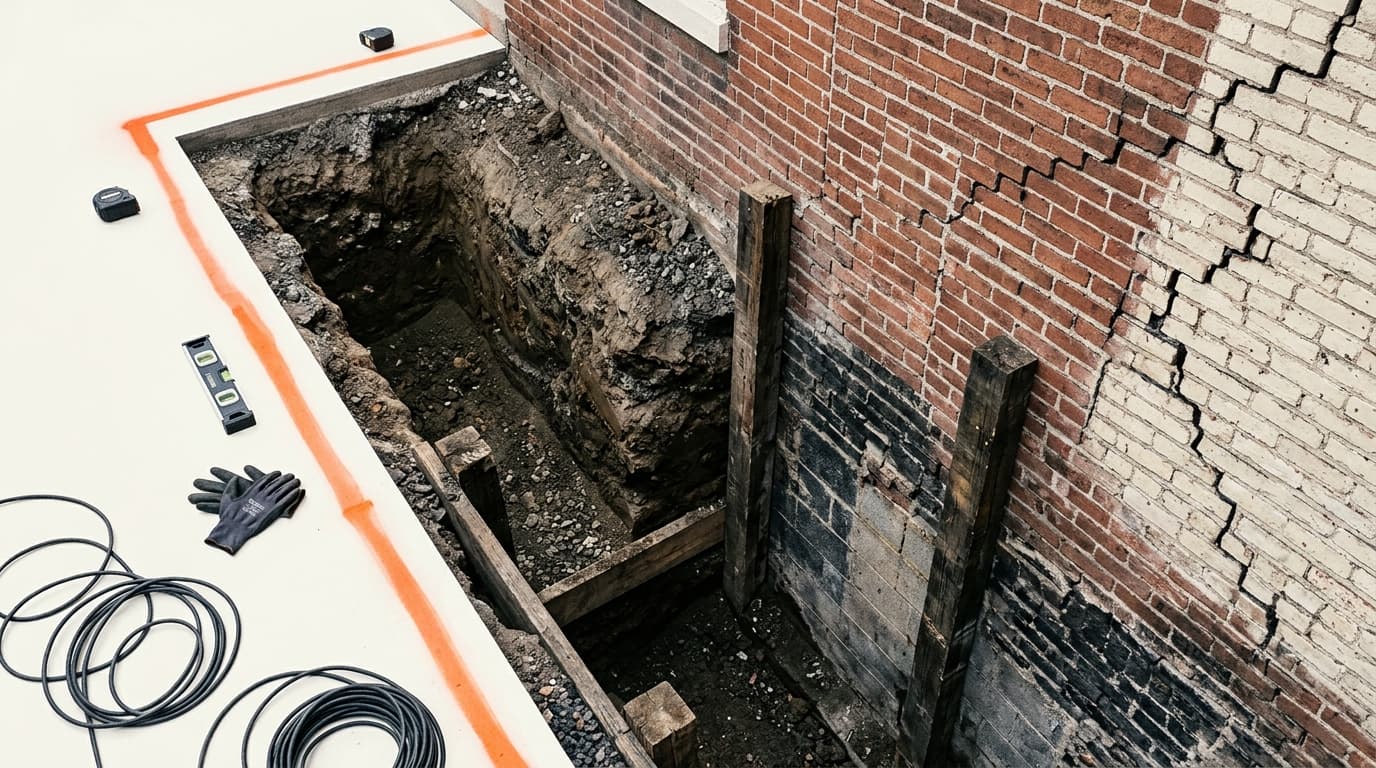
Neighbor Construction Damaged Your House in Pennsylvania: What the Law Gives You
If adjacent construction, excavation, or renovation work has damaged your Pennsylvania property, you have enforceable legal rights under multiple overlapping doctrines: common law negligence, the lateral and subjacent support doctrine, Philadelphia's Party Wall Act, and statutory construction code violations. The specific theory you pursue determines your damages, your burden of proof, and whether the contractor, the property owner next door, or both bear liability.
The Lateral and Subjacent Support Doctrine: Your Strongest Starting Point
Pennsylvania recognizes an absolute property right to lateral support: the right to have your land held in its natural position by the surrounding soil. This is not a negligence claim. A neighbor or contractor who excavates and causes your land or structure to subside is strictly liable for the resulting damage, regardless of how carefully the work was performed.
The practical significance is enormous. In a negligence case, you must prove the contractor failed to meet the applicable standard of care. Under the lateral support doctrine, you prove two things: (1) excavation occurred on the adjacent parcel, and (2) your property moved, cracked, or sank as a result. Courts in Pennsylvania have applied this rule consistently since Shrunk v. Schuylkill Navigation Co. was decided in the 19th century, and it remains good law today.
One important limitation: the absolute right applies to land in its natural state. When a building's added weight contributes to the subsidence, the standard shifts. The contractor still owes a duty of reasonable care for the additional load, but strict liability no longer applies to the structural portion of the claim. In practice, Philadelphia rowhomes are so closely packed that separating "land" damage from "building" damage requires expert testimony from a geotechnical or structural engineer.
Philadelphia's Party Wall Act and Rowhome Construction
Philadelphia's dense rowhome stock creates a specific legal problem that the Pennsylvania Party Wall Act (53 P.S. § 3201 et seq.) was designed to address. A party wall is a shared wall sitting on or near the property line, jointly owned by both neighbors. When a contractor performs demolition, addition work, or underpinning on one side, the shared wall is at immediate risk.
Under the Act, the owner initiating work that affects a party wall must provide written notice to the adjoining owner before work begins. The initiating party bears the cost of any repairs made necessary by the work, and the adjoining owner has the right to a pre-construction survey to document existing conditions. Skipping that survey is one of the most consequential mistakes an adjoining owner can make: without a documented baseline, proving causation becomes significantly harder when cracks appear later.
If you receive notice of planned construction next door, contact an attorney immediately. You have the right to request a preconstruction inspection, and that inspection record becomes the evidentiary foundation of your entire claim if damage follows.
Contractor Negligence Claims: Building a Viable Case
Where strict liability under the lateral support doctrine does not apply, or where you want to maximize your recoverable damages, a negligence claim runs in parallel. To prevail, you establish four elements:
- Duty: Contractors performing excavation or demolition owe a duty of reasonable care to foreseeable victims, including adjacent property owners.
- Breach: The contractor deviated from the applicable standard of care, such as failing to install shoring, ignoring OSHA excavation safety requirements, or violating Philadelphia's Building Code requirements for adjacent structure protection under Section 33 of the Philadelphia Construction Code.
- Causation: The breach caused your specific property damage.
- Damages: You suffered measurable economic harm: repair costs, loss of use, diminution in fair market value, or personal property loss.
Building code violations are particularly useful because they establish negligence per se. When a contractor violates a safety statute or code provision designed to protect adjacent owners, the breach element is effectively conceded, and the litigation shifts to causation and damages.
Who Is Liable: Contractor, Property Owner, or Both
Pennsylvania follows joint and several liability in certain contexts, and construction damage cases frequently involve multiple responsible parties. The analysis works as follows:
| Potentially Liable Party | Legal Basis | Key Factor |
|---|---|---|
| General Contractor | Negligence, lateral support doctrine | Direct control over excavation methods and shoring decisions |
| Subcontractor (excavation or demo) | Negligence, direct liability | Actual physical work on the site |
| Adjacent Property Owner (your neighbor) | Party Wall Act, lateral support, vicarious liability | Ordered the work; benefited from it; duty to protect adjoining land is non-delegable in some contexts |
| Architect or Engineer of Record | Professional negligence | Defective shoring plan or failure to specify protective measures |
| Permits and Licensing Authority | Rare; sovereign immunity applies in most cases | Generally not a viable defendant in Pennsylvania |
The non-delegable duty concept is critical for your neighbor's liability. Pennsylvania courts have held that the duty to provide lateral support cannot be contracted away. Your neighbor cannot escape liability simply by hiring a licensed contractor and standing back. If the work causes your foundation to crack, the property owner next door faces exposure alongside the contractor who performed the excavation.
Documentation: What You Must Gather Before Consulting an Attorney
The strength of a construction damage claim rises and falls on contemporaneous documentation. Start collecting the following immediately after you discover damage:
- Dated photographs and video of every crack, settlement, or structural movement, including reference marks to show progression over time
- Any pre-construction survey or inspection report you received or commissioned
- The permits pulled for the adjacent project (publicly searchable through the Philadelphia Department of Licenses and Inspections portal)
- The contractor's name, license number, and insurer, obtained from the permit application
- Written communication with your neighbor about the construction (texts and emails are admissible)
- Repair estimates from at least two licensed contractors
- A structural engineering report documenting the cause and extent of damage
The structural engineering report is not optional. Insurance adjusters and defense attorneys routinely attribute new cracks to pre-existing conditions, age, or settlement unrelated to the adjacent work. A licensed structural engineer who can testify that the crack pattern, location, and timing are consistent with excavation-induced movement is the witness who closes that argument down.
Statute of Limitations and Timing Risks
Pennsylvania's general statute of limitations for property damage is two years from the date of injury under 42 Pa. C.S. § 5524. Construction damage claims, however, sometimes involve latent harm that is not immediately visible: a foundation may shift gradually over months after excavation is complete. The discovery rule tolls the limitations period when damage was inherently unknowable at the time it occurred, but courts apply this narrowly. Do not assume you have two years from the date you noticed a problem. The clock may have started when damage first became objectively observable, which could precede your personal awareness of it.
If the adjacent construction is ongoing and you have already sustained damage, consider seeking an emergency injunction to halt the work while your claim is litigated. Pennsylvania courts have authority to issue preliminary injunctions where continued construction poses an imminent threat of irreparable harm to an adjoining structure.
What Damages Are Recoverable
Pennsylvania courts allow the following categories of damages in construction damage claims:
- Cost of repair: The full cost to restore your property to its pre-damage condition, supported by contractor estimates or actual invoices
- Diminution in value: Where repair costs exceed the property's market value, or where stigma from structural damage persists after repair
- Loss of use: Rental value of alternative housing if you were displaced during repairs
- Personal property: Furniture, fixtures, or belongings damaged by structural movement or water intrusion caused by the breach
- Consequential damages: Business interruption for mixed-use properties or home offices with documented revenue loss
Punitive damages are available in egregious cases where the contractor's conduct was reckless, such as proceeding with deep excavation despite clear warning signs of adjacent foundation movement and ignoring stop-work orders.
Philadelphia Contractor Damage FAQ
My neighbor's contractor damaged my rowhome foundation. Do I sue the contractor or my neighbor?
Sue both. Pennsylvania law imposes a non-delegable duty on property owners to protect adjacent land from excavation damage. The contractor bears direct negligence liability. Your neighbor faces liability under the lateral support doctrine and the Party Wall Act regardless of whether they personally did anything wrong. Naming both defendants preserves your recovery options and prevents either party from pointing solely at the other.
The contractor claims my foundation was already cracked before construction started. How do I defeat that argument?
A pre-construction survey is the definitive answer. If one was performed, it documents baseline conditions before work began. If no survey was done, a structural engineer can analyze crack patterns, fresh concrete exposure at fracture edges, and displacement geometry to distinguish new construction-induced movement from old pre-existing settlement. The burden of proving a pre-existing defect as the sole cause shifts to the defendant once you establish that excavation occurred adjacent to your property.
What if the contractor is uninsured or has shut down their business?
Pursue the adjacent property owner directly. As discussed above, the duty to protect your lateral support is non-delegable, so your neighbor's liability does not depend on the contractor having assets. Additionally, Philadelphia requires contractors to carry general liability insurance as a condition of obtaining building permits. If a permit was pulled, the insurer is identifiable through L&I records, and you can pursue a claim against that policy even if the contractor entity is defunct.
How long does a construction damage lawsuit take in Philadelphia?
From filing to trial in the Philadelphia Court of Common Pleas, contested construction damage cases typically take 18–36 months in 2026's docket environment. Many settle during discovery once engineering reports are exchanged and liability is clear. Cases involving complex subsurface issues or multiple defendants run longer. Emergency injunctive relief, if needed to stop ongoing damage, can be obtained within days of filing.
Can I get compensation for temporary housing if I had to leave my home during repairs?
Yes. Loss of use damages are recoverable in Pennsylvania property damage claims. You calculate them using the fair rental value of comparable housing in your neighborhood for the period of displacement. Keep all receipts for temporary housing, hotel stays, and storage costs. If your homeowner's insurance covered those costs, Pennsylvania's collateral source rule generally prevents the defendant from using that coverage to reduce what they owe you.
Disclaimer: For informational purposes only; does not constitute legal advice. Always consult a licensed attorney regarding specific claims.
