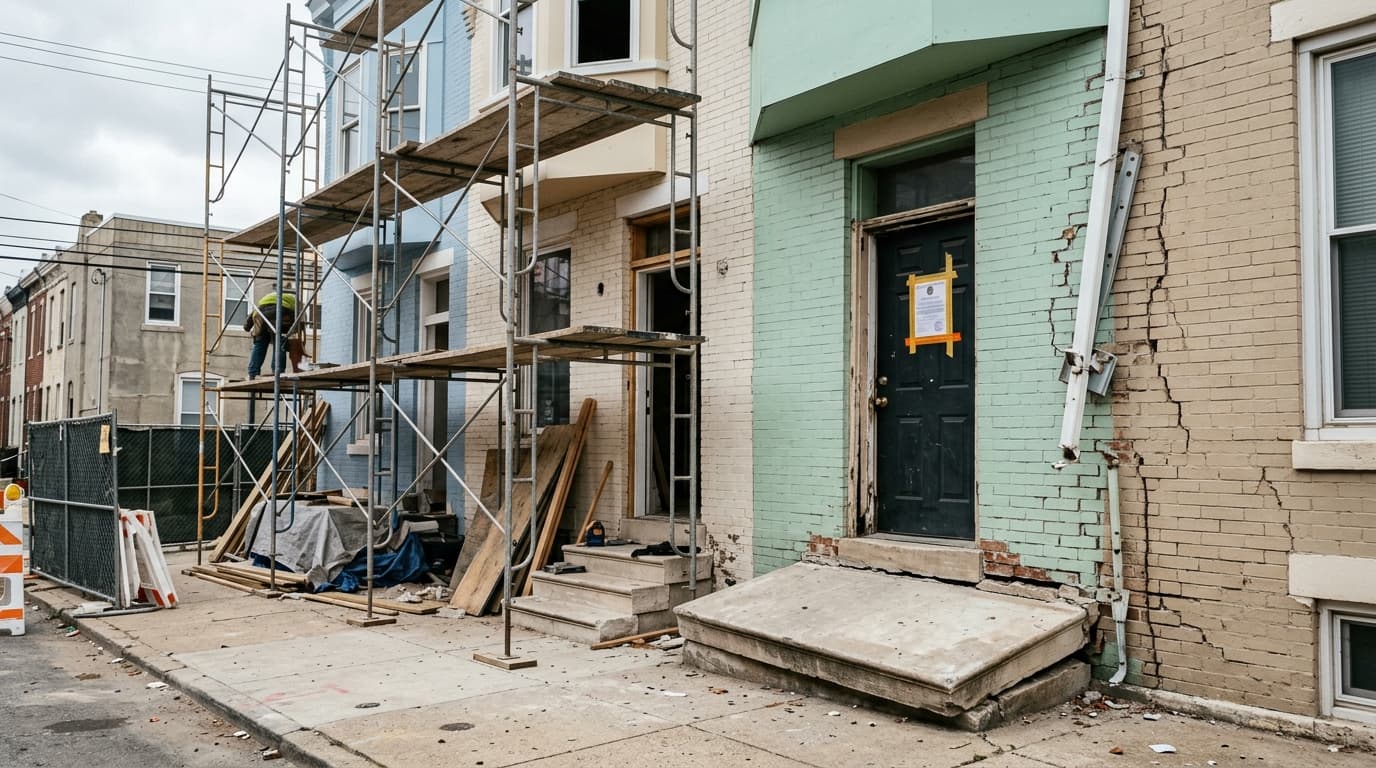
Neighbor Construction Damaged Your Philadelphia Rowhome: Here Is What the Law Gives You
When a neighbor's construction project cracks your foundation, collapses a shared wall, or destabilizes your rowhome, Pennsylvania law gives you enforceable rights against the contractor, the property owner next door, and sometimes both. The legal framework rests on three overlapping theories: the Pennsylvania party wall doctrine, strict liability for excavation damage, and common-law negligence. Understanding which theory applies to your situation determines how strong your claim is and how quickly you can move.
How Philadelphia's Party Wall Rules Create Shared Liability
A party wall is a structural wall that sits on the boundary line between two properties and serves both buildings simultaneously. In Philadelphia's dense rowhome stock, these walls are nearly universal. Under Pennsylvania common law, each adjoining owner holds an easement of support in the shared wall. That easement is not a courtesy. It is a property right, and interfering with it is actionable regardless of whether the neighbor or their contractor acted carelessly.
When a renovation on the adjacent property removes, undermines, or alters a party wall without your consent, you have a claim rooted in property law, not just negligence. This matters because a property-rights claim does not require you to prove the contractor cut corners. You prove the wall was shared, the support was removed or damaged, and your building suffered harm. Courts in Philadelphia and surrounding counties have consistently treated the easement of support as a near-absolute right, making it one of the strongest legal tools available to rowhome owners.
Before any adjacent construction begins, your neighbor is legally obligated to provide notice and, in many cases, obtain a building permit that accounts for the shared structure. If they failed to give you advance notice and damage followed, that failure strengthens your claim and may support an award of consequential damages beyond the direct repair costs.
Strict Liability for Excavation: You Do Not Need to Prove Negligence
Pennsylvania applies a strict liability standard to excavation work that damages an adjacent property. The rule derives from the common-law right of lateral support: every landowner is entitled to have their land supported in its natural condition by the land of a neighbor. When excavation removes that support and causes subsidence, settlement, or structural damage, the excavating party is liable without any requirement that you prove they were careless.
Strict liability is significant because it removes the most difficult part of a property damage case: proving what the contractor knew, when they knew it, and whether they deviated from industry standards. Under strict liability, even a contractor who followed every precaution can be held responsible if the excavation caused your wall to crack or your foundation to shift.
The strict liability rule applies to the land in its natural state. If your building adds additional load to the soil and that extra load contributes to the damage, courts may apportion some responsibility. However, in rowhome scenarios where both structures have existed for decades, this distinction rarely benefits the excavating party. The baseline expectation of support is well established long before any new construction begins.
Negligence Claims Against Contractors and Property Owners
Even when strict liability applies, filing a parallel negligence claim is standard practice because it opens additional avenues for damages and broader discovery into the contractor's methods. A negligence claim requires proving four elements: the contractor owed you a duty of care, they breached that duty, the breach caused your damage, and you suffered quantifiable harm.
In construction damage cases, the duty of care is rarely disputed. Contractors working in proximity to occupied structures have a recognized obligation to protect neighboring properties. Breach is typically demonstrated through evidence such as failure to install sheet piling before excavation, inadequate shoring of existing walls, ignoring engineer recommendations, or proceeding without required permits.
Property owners can also be held directly liable when they hired an incompetent contractor, failed to supervise work near a shared wall, or ignored early warning signs like visible cracking or settlement that appeared during the project. Under Pennsylvania law, an owner who retains control over the manner of construction work cannot insulate themselves from liability by pointing to the contractor as an independent actor.
Documenting Damage: What You Need Before You File a Claim
The strength of your claim depends almost entirely on the quality of your documentation. The following steps should happen as soon as you observe damage:
- Photograph every crack, gap, and area of displacement with timestamps, including the construction site visible in the background where possible.
- Hire a licensed structural engineer to inspect and issue a written report that attributes causation to the adjacent work. This report is the cornerstone of your damages case.
- Obtain repair estimates from at least two licensed contractors so you can present a concrete damages figure.
- Request copies of all building permits the adjacent owner pulled through the City of Philadelphia Department of Licenses and Inspections. Missing or incomplete permits are strong evidence of negligence.
- Preserve any communications with your neighbor or their contractor, including texts, emails, and any verbal conversations you can document in a contemporaneous written note.
- File a complaint with Philadelphia's Department of Licenses and Inspections if construction is ongoing. An official stop-work order creates a public record of the violation and can halt further damage immediately.
If you have homeowners insurance, report the damage to your carrier promptly. Your insurer may pay for repairs and then pursue subrogation against the responsible party, which effectively means they sue the contractor on your behalf. However, insurance recovery and a direct legal claim are not mutually exclusive, and you retain the right to pursue compensation that insurance does not cover, including loss of use, temporary housing costs, and diminution in property value.
Damages You Can Recover
Pennsylvania law allows rowhome owners to pursue several categories of damages when adjacent construction causes structural harm. The table below compares the primary damage types available under each legal theory:
| Damage Category | Party Wall / Lateral Support Claim | Negligence Claim |
|---|---|---|
| Structural repair costs | Yes | Yes |
| Temporary housing / loss of use | Yes | Yes |
| Diminution in property value | Yes | Yes |
| Personal property damage inside the home | Limited | Yes |
| Punitive damages for egregious conduct | Rarely available | Available when conduct is outrageous |
| Attorney fees | Generally not awarded | Generally not awarded (exceptions apply) |
Diminution in property value is a frequently overlooked but substantial damage category. Even after repairs, a home that has suffered documented foundation or structural damage carries a lower market value. A licensed real estate appraiser can quantify this loss, and it is fully recoverable as part of your claim.
Statute of Limitations and When to Act
Pennsylvania's statute of limitations for property damage claims is two years from the date you discovered, or reasonably should have discovered, the damage. In rowhome construction cases, the discovery rule typically starts the clock when cracks appear or structural movement becomes visible, not necessarily when the construction project began. Even so, delay is dangerous. Evidence deteriorates, witnesses become unavailable, and the responsible contractor may dissolve their business entity or shift assets. Filing a claim promptly also creates a legal basis to seek a temporary injunction halting construction if damage is ongoing or worsening.
If the construction project is still active when you retain an attorney, an emergency injunction is often the first move. Courts in Philadelphia County have granted temporary restraining orders stopping adjacent construction within 24–48 hours of an emergency filing when credible evidence of imminent structural danger exists.
Philadelphia Rowhome Construction Damage FAQ
Can I sue my neighbor directly, or only the contractor?
You can sue both. The property owner next door is responsible for ensuring that work on their property does not damage yours, particularly when a party wall or easement of lateral support is involved. The contractor is independently liable for negligent work methods. Naming both defendants maximizes your recovery options and prevents either from shifting all blame to the other.
What if my neighbor's contractor had insurance?
Pennsylvania law requires licensed contractors to carry general liability insurance, and that policy should cover damage to adjacent properties. Your attorney will send a preservation letter and a claim to the contractor's insurer immediately upon retention. However, insurance carriers routinely dispute causation and damages, so having your own structural engineering report and legal representation is essential to securing full compensation rather than accepting an inadequate settlement.
Does the Philadelphia party wall doctrine apply to rowhomes built in the 19th century?
Yes. Age of construction does not limit the party wall easement. Courts have applied the doctrine to properties built well before 1900. In fact, older construction may strengthen your claim because long-standing mutual use of the wall is well established and the neighbor's obligation to preserve support is unambiguous.
My foundation cracked six months after construction ended. Is my claim still valid?
Likely yes. Foundation settling and subsidence damage frequently appear months after excavation because soil compression and groundwater changes continue after construction stops. The discovery rule anchors your two-year limitations period to when the damage became apparent, not when the shovel first entered the ground. A structural engineer can document the causal connection between the excavation and the delayed manifestation of damage.
What if the city issued a permit for the adjacent construction?
A city-issued permit does not shield your neighbor or their contractor from civil liability. The permit process verifies code compliance on the permit applicant's property. It does not authorize the permit holder to damage yours. Liability for party wall damage and failure of lateral support exists independently of whether the work was properly permitted on the other side of the wall.
Disclaimer: For informational purposes only; does not constitute legal advice. Always consult a licensed attorney regarding specific claims.
